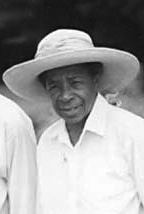
1923 Juanita is born in Ohio. She grew up
in Cleveland.
1939 Juanita initiates her first civil rights
action at age sixteen, by sitting in every car of a Jim Crow
train headed for Georgia.
1943 Juanita’s action at a drug store lunch
counter results in her first arrest. She is a nineteen-year-old
sophomore at Howard University in Washington D.C.
1943 Juanita helps to “open”—desegregate—the
Little Palace Cafe on the edge of the Howard University campus.
1944 Juanita is co-founder of the Cleveland
Committee of Racial Equality, affiliate of the National Congress
of Racial Equality.
1944 Juanita meets Wally Nelson. Working
as a journalist; she interviews him while he is in jail as
a conscientious objector.
1947 Wally participates in the Journey of
Reconciliation, the first “Freedom Ride.”
1948 Juanita and Wally become partners and
join Peacemakers. They become war tax resisters.
1948-1955 Juanita and Wally join in community
with Marion and Ernest Bromley in Cincinnati, Ohio.
1957 Juanita and Wally move to Philadelphia.
1957 Juanita and Wally spend four months
at Koinonia Farm in southwest Georgia.
1959 Juanita is brought to federal court
in Philadelphia for war tax resistance.
1970-1974 Juanita and Wally homestead in
Ojo Caliente, New Mexico.
1974 Wally and Juanita move to Woolman Hill
in Deerfield, Massachusetts, where they start an organic vegetable
farm and help organize the Greenfield Farmers Market.
1975 Juanita and Wally Nelson stimulate
the organization of the Pioneer Valley War Tax Resisters.
1978 Juanita and Wally Nelson are founding
members of the Valley Community Land Trust, whose residents
do not own the land, but have ninety-nine year renewable leases.
1988 Juanita publishes A Matter of Freedom
and Other Writings.
2007 Juanita continues to live in Deerfield,
Massachusetts.
Complete Interview
Audio Clip #1: Juanita grows up and goes to school in Cleveland;
her first action, her first arrest (04:54)
Wait for the file to download, then click the arrow to play the audio.
My name is Juanita Nelson. I live in Deerfield, Massachusetts,
up at Woolman Hill, which is a Quaker Conference Center; actually
Friends, but we call it Quaker. I was born in Cleveland, Ohio,
in 1923 and lived as I very often say in the outer slums of
Cleveland. And, for instance, we didn’t have our first
telephone until I was seventeen and won a poetry contest, and
I used the money for the first telephone my family had. I…was
terrible—I liked school, and I didn’t ever miss
school until I was sixteen years old and I went with my mother
to visit her parents in Georgia. That’s where I guess
I did my very first action, because our train was late for
changing in Cincinnati and we were rushed into a car. By the
time we got settled, I recalled, I looked around and saw that
we were in a Jim Crow car. Now I’d heard of these things,
and I knew about that sort of thing.
INTERVIEWER: Would you explain what a Jim Crow car is, for
people who don’t know?
This was at a time when all people who had darker-colored
skin, or part dark African ancestry, were seated in a particular
place and could not go anywhere else—in streetcars and so forth.
In the South particularly they had fountains that said, “whites,” “colored,” all
that sort of thing. It was a very much division in talking
about races, which I don’t like. I think there’s
one race anyway, as far as I’m concerned. So I asked
my mother if we couldn’t change cars and she said, “Oh
Nita, I’m just tired.” And I think that was true.
And I sat and fumed, and finally I got up and sat in every
car in that train because I was so upset, and my recollection—this
was a long time ago, of course—is that nobody bothered me except
the porter, and he was afraid that something would happen to
me, because he had the same color skin that I had. Then I went
back and sat by my Mother and I felt better because I had expressed
myself. But, anyway, that was it. But I did go [to school]—even
though we were very poor, we were pretty well settled because
I went to the same elementary school, all the way through,
and the same junior high school and the same high school—senior
high school.
And after I did that I had thought I wouldn’t go to
college even—my Mother wanted us all to go to college, and
I didn’t have any jobs, as poor as we were, much because
she wanted us to be able to study and that sort of thing. I
was in the Girl Scouts, which I would never do again, of course
[chuckle], but one of the scout leaders had gone to Howard
University in Washington, DC, which at that time was what we
call an all-black, pretty much an all-black college, and I
did apply for that and I got a scholarship, otherwise I couldn’t
have gone.
And so I did go to Howard University, and that was where I
was arrested for the first time. I went with two of my friends
who were undergrad coeds, downtown in Washington, DC, which
was about as segregated as anyplace in the United States at
that time. I went to Howard in 1941. This was in ’43
though, at the beginning of the year, I think. And we went
to a drugstore that had a lunch counter…asked for some
hot chocolate. We were told, “We don’t serve Negroes.” We
said, “Well, we’d like to see the manager.” “The
manager isn’t in.” And we said, “Well, we
have plenty of time. We’ll just sit here.” And
finally they brought the hot chocolate, but they gave us tickets,
bills for 25 cents, when it clearly stated on the board that
hot chocolate was ten cents a cup, so that’s what we
put down. And I always like to say that’s probably all
we had anyway. But, then we walked out and were met by—my
recollection is—seven of DC’s finest, that is,
the police. And they put us in the paddy wagon and took us
to jail.
Audio Clip #2: Eating in jail; leaving Howard University; first
job at a newspaper; meeting Wally; CORE ( 05:24)
At that time, I guess we were sort of hyped up. We thought
this was a great lark: real life! We’ll get to eat with
the real convicts, and so forth and so on. But the Dean of
Women came and got us out before suppertime. And I always say
that that saved me from ever eating in jail. I’ve been
in jail a few times since then, and I’ve never eaten
when I was in jail, but I would have eaten that time, [chuckle]
and I’m sure the food wouldn’t have been very good
anyway.
I left Howard after two years, partly because I felt my family
couldn’t really keep me there, even though I had a scholarship;
I had to buy books and travel once in a while to go back home
and that sort of thing. And because we were in the midst of
World War II, when I got back I was able—at nineteen—I
was able to get a job at a weekly newspaper for which I had
written a column from Howard about students from Ohio who were
at Howard. So I did that and—let’s see, I can’t
remember how long I was there before those of us who were on
the staff, who were reporters, wanted to start a chapter of
the Newspaper Guild, and the publisher, the owner, said he
would tear his building down brick by brick before he would
allow a union, and he did fire all of us. But then he had to
take us all back because—I don’t know what the
legislation was or whatever, but he had to take us back. And
I stayed on for a while, and then I quit.
But the best thing that ever happened to me, being a reporter:
that’s where I met Wally—how I met Wally—who
became my life partner. He was in prison, in jail at the time,
in the Cuyahoga [Ohio] County Jail because he was a conscientious
objector; that is, he would not go to war. And he signed up
as a conscientious objector and was put in one of the camps,
CO camps, called “civilian public service,” although
he called it “civilian public slavery.” But he
realized, soon after he got there that he should never have
registered, period. He was there for about a year, and he,
with five cohorts, walked out of CPS and went to Detroit and
they started a service in a poor community and all that, but
of course they were finally picked up. The reason I met him
was that the sheriff asked our paper to send a reporter down.
Well, two of us went down, and Wally and his friend who were
there saw us pass through, escorted by the sheriff, and decided
that, “Oh, they must be pretty important.” So they
had outside contacts, mostly Friends, Quakers, and they found
out who we were. So they asked me to come down, and so I started
visiting them. And I became a pacifist for sure. I was never
not a pacifist; I wasn’t a warmonger or anything like
that, but I just hadn’t thought about it. And I shall
never forget that, asking him, “Well, what would you
do if…?” as people are always asking, “…if
you were pretty sure someone was trying to kill you?” And
he said, “I would try to protect myself by putting my
hands over my head maybe, that sort of thing, but in the end
I couldn’t decide that my life was worth more than somebody
else’s.” And that really…I guess I was ready
for it, and that really moved me. And that was a very life-changing
thing for me.
I had already been involved in CORE, the Congress of Racial
Equality, that helped to start a chapter of CORE in Cleveland,
along with a man named George Howser, who worked for the Fellowship
of Reconciliation. That was a sort of a religious oriented
organization, peace organization…I didn’t belong
to, but we started the CORE group there and worked on an amusement
park, tried to open it up, and had many adventures, and mis-adventures.
I guess I was chairman, and we used to meet at my house. When
I went back to Cleveland, I lived back at home with my parents,
and my mother was very interested particularly, and so—did
a lot around that. … Cleveland was no bastion of freedom—sometimes
you couldn’t—there were theaters you couldn’t
go to; we tested restaurants, all that sort of thing. It wasn’t
quite as blatant as it was in the south.
Audio Clip #3: Getting called “nigger”; Wally’s
hunger strike in prison; getting to know Wally; “joining
their fates” (04:48)
I guess I remember very well, when I was, I think it was in
junior high school, somebody called me “nigger.” And
I went home, crying, or anyway, very disconsolate. My mother
said, “Why are you worrying about…you know who
you are.” So… [laugh] I’ve always appreciated
that.
Well, anyway, so we worked on that. And then, I finally quit
the newspaper. I had nothing I wanted to do with it anyway.
And by that time I had decided I didn’t want to be professional
ever, and I haven’t been, either—that I would
do whatever job to keep body and soul together, that was good
work, or at least not bad work, let’s put it that way;
at least wasn’t bad work. And that I would just live
my life and do the things that I believe in.
Well, Wally and his friend were in jail, by the way, because
they had been offered the opportunity, in quotes, to go to
federal prison while their case was on appeal. But they said, “We
don’t choose to serve.” And you see, you have to
sign something...”I choose to serve.” They said “We
are not choosing to serve,” so they were there for a
year, which time would not have counted on the five-year sentence
they finally got that was upheld. But he was sent to prison,
first to Milan, Michigan, and then to the prison in Connecticut,
which is…now a women’s prison, which is interesting.
I corresponded with him; although interestingly enough I wrote
to his friend because they could receive only seven letters
a week each and they knew pretty much the same people. And
I drew his friend Joe, and so we kept up a correspondence.
And then when he was released after a total of thirty-three
months, including the county jail and the federal prisons,
he was on a hunger strike after a while. He said, “You’ve
got me in jail; you’re responsible for this, and I am
not going to eat until I am on the other side of these walls.” Well
for eighteen days he didn’t have any food, and then they
started force-feeding him. I can’t ever remember quite…I
think altogether it was a total of at least 87 days, and that
he…didn’t eat for 18 days, and then was force-fed
once a day, ‘cause they wouldn’t submit to any
more of the—that’s a long story so I won’t go into
that. The first time they tried to feed them, they held them
down ‘cause they…deliberately put tubes too big;
it went through his nose down into stomach, esophagus, or whatever,
however it is. And, so he lost a lot of weight, and then went
to St. Paul to recuperate with a brother, who was a minister,
and then came to Cleveland. And then, that’s when we
really got to know each other; you know, you don’t know
somebody when they’re in prison, you know I mean [chuckle]
how can you know them really? And I didn’t even visit
them, at that time either. But anyway, then in 1948—he
was released in ’46, I think it was, ’46, ’47—and
in ’48 we decided that we would join our fates and so,
we became—what do they say these days, “an item”?
[laugh]
And at that same time—maybe I should go back a little
bit—about the civil rights thing. It turns out that
Wally and I had both been involved in CORE. He had been in
college in Ohio. That’s how he happened to be in jail
in Cleveland, because that was the state where the crime was
committed, when he walked out of Coshocton CPS, and when he
would go back to Chica—at that time he was living in
Chicago. He was born in Arkansas, but he went back to Chicago
and he would do some testing for CORE, which was started in
the early, I think about ’42, 1942.
Audio Clip #4: Forming Howard University’s “Civil
Rights Committee”; “Opening” a restaurant;
Juanita explains “opening” and “testing”;
becoming a tax refuser; dealing with the IRS (05:38)
Then I had been involved in CORE. I was also involved when
I was at Howard; I’d forgotten about that. After we had
this incident that I was talking about, of trying to get the
hot chocolate, a woman who became a very dear friend, Polly
Murray, was there. She was about ten years older than us coeds.
She was in law school, and she knew about CORE that had started.
And we formed the Howard’s—I think it was called “Civil
Rights Committee” and actually opened up a restaurant
on the edge of campus in one week, less than a week. I never
had such a quick victory, [chuckle] never since that time.
It was just a sort of a greasy spoon restaurant, but it was
a heady victory for us. We had a picket line; we had a sit-in;
lots of people agreed with us, and he capitulated.
INTERVIEWER: So, when you say you “opened up a restaurant…”
I mean we desegregated it. I always forget that; people don’t
know exactly what I mean. And so that was very good. So that
happened before I left. I sometimes regretted having left Howard
because they did some bus testing. Because you know, DC is
surrounded—Virginia, Maryland and so forth, and they
were all, of course, very segregated, too.
INTERVIEWER: Will you explain the concept of “testing”?
You try to do something. Like, for instance, if blacks were
supposed to sit from the back, you would just go and get your
ticket and sit in the front and see what happened. Most often,
you’d just be arrested or that sort of thing.
So that’s what they were doing. And meanwhile I was
working in CORE in Cleveland though, when they were doing that,
so I didn’t get into that part of it.
Let’s see, where was I when I digressed?
INTERVIEWER: You were working at CORE, you had just become
an “item.”
That’s right and so we lived in—we didn’t
have any money—we lived in Cincinnati with a friend
of Wally’s who was a minister, and was doing some work
on his church and Wally helped him do that. And then we moved
into Cincinnati proper, and we ended up—that same year
of 1948 when we began living together, a group called Peacemakers
was formed. They saw nonviolence as a way of life, not just
a tactic, or different campaigns, and one of the things that
was a hallmark of Peacemakers was refusing to pay taxes for
war, and so I say that that was a very pivotal year in my life, ’48.
Wally and I started living together; I became a tax refuser;
we became tax refusers. You see, he spent thirty-three months
in prison because he wouldn’t go; how was he going to
pay for somebody else to go and kill people? We just had no
problem with that. So we always had to find work where there
were no taxes, either be self-employed, or at that time I did
say Wally was my dependent. He did odd jobs; he didn’t
sign anything—and so I could earn at that time, I think
it was twelve—twenty-five dollars on any one job. So
if I would’ve had two jobs, neither employer would take
taxes out, but I made more than—I mean I made the taxable
amount and said, “nyah, nyah, nyah…I’m not
going to pay you.” Our tax refusal included not filing,
not for being secretive, but because we just didn’t feel
that we needed to do that, that we owed any allegiance to a
system whose major business was killing. ‘Cause most—about—at
least half of the budget is for the military. It was then;
it is now, continues to be. But we were very open. We…always
demonstrated. For a while we wrote letters to our congress
people and the president—that got boring, so I quit
[chuckle] doing that. And so they knew it, because they would
sometimes call us up and say, “We want your records,” and
so forth, or “You come down and see us,” and we
said, “Well, we’re not interested in coming; if
you want to see us you can come to our house, and we’ll
tell you why we are refusing but won’t give you any information.” So,
that went on throughout our lives, I guess for a long time.
Audio Clip #5: GANO Peacemakers; living with the Bromleys; “the
birds and the bees don’t live together…”;
Juanita goes back to college; Wally gets spinal meningitis; moving
to Powelton Village (05:07)
And then finally—Peacemakers also didn’t believe in
interest and private land, land to be private—land
trusts and so forth, and community. For seven years we lived
in community with another couple, just outside of Cincinnati,
called GANO Peacemakers, G-A-N-O. That was the enclave where
we lived. That was a very interesting thing because we knew
that Cincinnati was very, very bigoted, in general. And so,
Ernest and Marion Bromley, the couple with whom we lived, bought
the house, and … then, of course, we all moved in. And
for a while I think it was fine because they thought we were
the servants, and when they found out we weren’t, there
was pandemonium there.
We lived right across from the church. Once Wally and Ernest
went over there. There was some kind of program, and those
people were so nasty; they felt that they would really harm
them. When they walked out, they didn’t look back, but
they heard one woman say, “Don’t do it, don’t
do it.” So we don’t know just what—we never
knew exactly what it was they said they shouldn’t do.
And there somebody said to us, “The birds and the bees
don’t live together; why should the blacks and the whites
live together?” [chuckle] But things calmed down. One
man was very nice; he came and played his autoharp for us,
and so that was very nice. After a while we didn’t have
anymore trouble and got to know a few of the people, not many,
but—and anyway that was a very interesting interlude.
And as I said, I think we lived together for seven years.
And then Wally and I left because we decided we wanted to—I
went back to school. When I was on the newspaper, I did go
back to college and finish because I’m sort of compulsive.
I don’t know why I bothered. I went to Western Reserve
and got a degree —working on the newspaper—got
a degree in reporting, in journalism, which was kind of crazy.
And then I—what my work was so often—I did
all sorts of odd jobs when we were living in Cincinnati and
so forth. I was at the Art Museum as a model for people who
were painting and drawing; I worked at a historical society;
I typed a lot of envelopes, and that got a little boring. So
I decided to go back to school…ten years after I’d
been in college and I went to Ohio State and got a degree in
speech therapy, speech correction, thinking I could get part-time
work doing that. It didn’t work out all that well, but
anyway, I did that. But it was after I got out, sometime after
I got out, that we—well, one thing, Wally got spinal
meningitis when I was in college, and I had never—I
thought only kids got that and thought he was going to die.
But because—it was only because a few years before
there had been some drug that had been discovered that saved
his life. And that was the only time we ever contacted the
IRS because somebody had been out to the house where we lived
with the Bromleys—some agents, a couple of agents—and we thought
we ought to let them know that they might have been exposed
to meningitis, so we did call them one time; that was the only
time.
We had a friend who lived in Philadelphia, and he was doing
what they called “interracial housing.” Now Wally
would never let anybody say that; he said, “Interracial,
you mean, a monkey and a human being,” et cetera, they
might be different races. But anyway, Wally really was recuperating
and this friend was a builder, and he said we could come and
live in one of the houses he was working on, and Wally could
do whatever he could, so that’s how we got to Philadelphia,
and we lived in a place called Powelton Village, which was
known for being, supposedly, a diverse community near the University
of Pennsylvania.
Audio Clip #6: Making a living; loaning money; living at Koinonia
Farm in Georgia (05:39)
So we lived there, and of course I did other jobs that were
just routine office things, different kinds of things. By that
time Wally had become a salesman, because as a traveling—as
a salesperson, a manufacturer’s representative, you get
your own money and then you’re supposed to file, and
so forth. He sold bookplates for the Antioch Bookplate Company.
We knew Ernest Morgan who had started this, and he said it
was a half-baked Socialist group. His father, Arthur Morgan,
had been president of Antioch College for a while.
But anyway, Wally started doing that, and of course it was
hard going at first. He had all of New England, but we made
a living. We never made much money, but we never spent much.
As a matter of fact, we used to lend money to friends sometimes
[chuckle] because we so hated this interest thing anyway, that
if somebody needed to buy a car—I don’t mean
we had tons of money—maybe a friend would, we would
lend him some money, obviously at no interest. And the other
thing is I don’t like having money hanging around; what’s
the use of having it doing nothing? So [chuckle] that came
in handy a little bit later, too.
So we lived there; I think we moved there in ’58, 1958,
I think. But before we could even get settled in Philadelphia,
we got a call, “Would we go down to Georgia to Koinonia
Farm?” which was an intentional community where people
just put everything they had into the community. They were
really being bombarded by the Ku Klux Klan because they had
no barriers as to color. Their farm market was bombed and destroyed,
and the kids were harassed on the buses. It was just terrible.
They did finally get—there was one native black family
that joined the group and, if things were bad before, it just
worsened. It was so bad that the father of that family—it
was a large family—was too afraid to stay there, so
they left and went up to New Jersey where they had hoped to
start another community. That didn’t go, but they hoped
to do that. And Clarence Jordan, [pronounced “Jerdan”]—that’s
the way you pronounce it in the south—Clarence Jordan,
who had been the founder of Koinonia, asked if we would come
down. That’s the only time I’ve ever done anything
because of color, because they didn’t want those people
to think that they had changed their thought, they made them
change their minds about accepting all people. So we had been
cheering them from afar, so we thought we had to go. So we
were down there four months and there were about nine shootings
into the community while we were there, but we were very fortunate.
Nobody got hurt. It was amazing; it was absolutely amazing.
That was quite an experience being down there in the Deep South,
with all that going on.
What they finally did was set up a watch, put a light up on—the
farm was on two sides of the road—and so they put a
light up, and people would be on watch. They didn’t want
us to be on watch. They thought we’d be in more danger
than other people, but we said, “Yeah, we wanted to be
a part of it.” So, we did, and I’ll never forget
that the first night we were out there, we were sitting in
the car—there was a car parked there—and, you
know, you could…cars going both ways, and a car came
up behind us, was coming up, we could hear this…instinctively
we ducked and immediately felt like fools for doing such a
thing…[stutters] ‘cause, as a matter of fact,
that would be the most dangerous thing we can do. But we never
knew whether there was anything. From then on, whenever we
heard a car coming from behind, we’d get out of the car
and stand under the light, which is, tactically and morally,
for me, the best thing to do.
But that was quite an experience, ‘cause I had never
lived in the South. I said my parents were both from Georgia,
and I had been there, but I had never lived in the South. And
that was a rather harrowing experience. They stopped selling
stuff to Koinonia, and so Wally would take—he said
he never had seen a hundred dollar bill before—he’d
take these hundred dollar bills and go up to far places and
buy supplies for the farm and stuff. Then if that was discovered,
he’d have to go further, and so on, but he was never,
never really hurt.
Audio Clip #7: Koinonia Farm and Clarence Jordan; talking about
religion; moving to Ojo Caliente; Wally’s early years on
a plantation (05:21)
INTERVIEWER: What were the years that you were there?
We were there—I think it was’58.
INTERVIEWER: And how do you spell the name of the place?
Koinonia is spelled K-O-I-N-O-N-I-A. It’s a Greek word,
and right now I can’t think of what it means, but anyway
it’s a Greek word. Clarence was a Greek scholar, a Baptist
minister. They… invited us to join the community, which
surprised us ‘cause neither of us was religiously oriented,
although Wally had been very active in the Methodist church
when he was growing up. But I was very touched by that, that
we were asked to join, and also touched because Clarence said,
as much as he was—you know, he wrote the Cotton Patch
Bible of translates, for the New Testament, but I so much remember
hearing him say, “Religion is a private thing; it’s
what you believe,” and I’ve never heard, I’m
sure, anybody who has something of a fundamentalist religion
say something like that. And he was very, very funny. I know
that during those days before we came down there, somebody
came around, like some of the Ku Klux Klanners came around
and, once they came and—‘cause blacks worked
on the farm even before anybody moved there, and so they would
eat lunch together, and one of these guys came and said, “Preacher,
I don’t wanna see the sun set on you havin’ niggers
here anymore.” And Clarence reached out his hand and
said, “Well, I’m so glad to know you, I’m
so glad to know somebody who can keep the sun from setting.” He
was funny. He died when he was 68, which was much too young,
but of a heart attack.
Then we went back to Philadelphia after that and stayed there.
Our house was the center of tax refusal. Meanwhile, I could
tell—well, I’ll just go ahead with this and then
I’ll tell some more.
It was in 1970 during the Viet Nam War. We were refusing to
pay taxes; we were working in CORE [Congress of Racial Equality];
we were working with the great brokers, Cesar Chavez and those.
Wally fasted for twenty-three days once in front of one of the big
chain stores to try to get them to stop using, either grapes,
or something, whatever it was that they were doing. And yet,
we began to feel, and I in particular, that our whole lives
were tied up in war stuff, because we live on this war system.
I have something at my house now—somebody sent it;
it says, “Peace would destroy civilization as we know
it.” And indeed it would, because we could not consume
with, 5% of the population that we have, forty, fifty, whatever
percent of the world’s goods. And we have bases all over
the world and so forth. So, anyway, I felt as though I wanted
to remove myself to some greater extent from that system, and
so we left and we ended up in New Mexico in a village of five
hundred called Ojo Caliente, pretty much a Spanish-speaking
place, where I had my first garden…started learning
to….Wally had some experience at…
Wally actually lived—three years of his life, his
family had lived on plantations because his father was a Methodist
minister with a lot of kids—didn’t make much
money, and he wanted to farm and that was the only way he could
do it. And that was another thing that formed Wally about this
business that people are just people. For two years they worked
on the plantation of a, in quotes, white man, and he had both
blacks and whites. They lived separately, but treated them
all the same, pitted them one against the other. As Wally would
say, he’d ask the poor whites to do something and if
they complained he’d say, “That’s alright,
I’ll go and ask the niggers; I’ll tell the niggers
to do it,” and vice-a-versa.
Audio Clip #8: Wally’s early years on a plantation, continued—Settling
up with “Mr. Charlie” on the plantation; “people
are people”; living in New Mexico; moving to New England
(04:49)
The second year when his father went to settle up with Mr.
Charlie—that’s what they called all these bosses;
I don’t know whether that was really his name—and
Mr. Charlie said, “Well, Preacher, you’ve got a
fine family. You work hard,” and all that, and then next, “You
only owe me 500 dollars,” and Wally’s father said, “Wait
a minute. According to my calculations, you owe me five hundred
dollars,” and Mr. Charlie said, “Wait a minute!
I don’t have niggers figuring after me,” and he
put’em off the plantation. Of course, Wally said, the
kids were delighted [chuckle] ‘cause they wanted to go
back to Little Rock anyway. Then the next time they did the
venture, they worked on a plantation owned by a black man,
and he said it was the same thing. He didn’t have any
whites on his…, except that you could call him by his
first name, but he was trying to get everything he could out
of everybody. No different, no different. And that’s
something I believe, and it’s discouraging; it really
is discouraging, but people are people. Everybody seems to
want to just wring everything they can out of people, and all
of us do. This is society. [pause] I don’t know, I’ve
heard some figures—one percent of the population of
the United States makes thirty times as much as a regular worker.
And to say a worker is… that’s like an epithet.
The worker is the ones who keep the world going, so what’s
[laugh] I don’t really quite understand that, but that’s
the way it seems to be.
We did go there and live there for three and a half years.
We went in ‘70 and left in ‘74. We learned to love
it. We were in northern New Mexico, not so far, at 6800 feet.
We always liked New England, but we thought, “Oh, we’re
going to homestead, we need to be in a warm place—ha, ha, ha.” The
climate, in a sense, was somewhat the same, in a different
way. It would be, could be warm; it would get very warm. It
was always cool at night. We couldn’t even get ripe tomatoes.
We had to pick them green because they wouldn’t get ripe.
They ripened all right after we picked them. And that’s
where I learned to can and dry things. We wanted to stay, but
we found we didn’t have enough money to buy land. We
thought we would there, but it was too expensive, so that’s
how we ended up in New England.
We met somebody who came through who ended up himself at Woolman
Hill when there was an alternative school there, and they did
farming, did gardening and canning, and they had two cows and
so forth. And Randy Kehler wrote to us and said, “Our
farmer is leaving; would you like to do this?” Because
when we met him, we said if we couldn’t find anything
within the next few months, we were going to come back east.
And we said, “No, we don’t want to be a farmer,
even if we don’t get paid—we want to homestead.” And
we ended up being able to do that. We came here in ’74,
took down a house; I took out millions of nails. We did all
our work by hand. We didn’t know anybody but Randy Kehler
when we came here, and we got to know so many people, and so
many people helped us. Some of ‘em came to help, so we
finally even put in an electric line over to Traprock so that
people who had Skilsaws and all that sort of thing could work.
And our house…we lived pretty much the same, I lived
pretty much the same as we did… well, I don’t
know how you could compare that, but…In New Mexico we
had an outhouse—we had a designer outhouse because an architect
friend of ours visited us and designed the outhouse. [chuckle]
We lived in an adobe that had 18-inch thick walls. Our landlady
lived down about a quarter of a mile down the road from us.
Audio Clip #9: Life in New England; eating locally; tax refusal;
the “lines” between people (05:36)
We drew our water up by hand. We had electricity there because
I think in the ‘30’s, there was some kind of program
there to electrify rural places, so we had a light bulb in
each room, something like that. And so, that was an extraordinary
experience. I’ve never had a… we’ve never
had a garden so beautiful as that one—everything germinated. ‘Cause
you had to have irrigation anyway, but it was not the kind
that you have here where you use electricity and pump; I guess
it was something electric, intermediately, but it was a system
that had been built several hundred years before; the water
came from the mountains when the snow melted, and then you
would have water in to your plot. People had certain times,
but because our garden was so small, anytime the water passed
we could open up our gate and irrigate.
Then we came here. And here we have an outhouse, which we
probably wouldn’t be able to get permission to have now,
and we built our house from salvaged material. We used kerosene
lamps for a while, and now I have two gaslights. What else
do we do? We grow most of our food; I don’t buy stuff
that’s imported, except I have to buy oil. But there
are so many things here that you can buy: eggs, local eggs;
you can buy cheese, there’s cheese that’s made
here; there’s pickles, sauerkraut—although I
make my own sauerkraut. I make sauerkraut. I can a lot of things;
I dry things, and so I have plenty to eat. I just eat differently
maybe from other people. My winter salad is, say for instance,
pickled beets and sauerkraut—it’s wonderful together.
And I’ve discovered making parsnip salad in the spring
because parsnips can stay in the ground; and once the ground
thaws you can pick them. And I grate them, and put some oil
on them. And then if you have had parsley, it comes back for
a while—put a lot of parsley in it… absolutely
delicious.
Wally has never been anywhere where he hasn’t started
a tax refusal group and he started that, and so we’ve
had a pretty vital one. Right now it’s in sort of a quasi-dormant
state. I mean it goes up and down, and a lot of people here
have, relatively—obviously it’s not a very big
movement; I wish it could be. That’s the only way you
can stop war, stop participating in it, and stop so much consumption
that requires war, at least that’s the way I look at
it.
INTERVIEWER: Could I ask you to back up and talk about—now
I hesitate to use this word—but talk about the Viet
Nam War, related to race relations? I hesitate to use that
word after all you’ve said, but just—what relationships
were like during the Viet Nam War between black people and
white people.
Here, in the states?
INTERVIEWER: Yeah, just in your experience.
I don’t know; I guess maybe I’m atypical, but
I know that the groups I work in—for instance, CORE
had no color line, and Peacemakers had no color line—didn’t
have any age line either. For a while I think I was about the
youngest person in Peacemakers, and I felt very close to somebody
who was in her 80s, and…even now, I don’t feel
that age difference. I mean, I’m getting older; I know
that. But I have friends who are one-third my age, one-fourth
my age, and we’re just on the same—boundary. So I don’t
really know that—I really couldn’t tell you much
about that, because, or couldn’t speak much to that.
I think most of the people who were people who were against
the war, or in a very active way, and I don’t mean just
saying it, but doing something, didn’t have those kinds
of barriers, weren’t divided into that… Now in
the general population, I honestly don’t know.
Audio Clip #10: Being arrested and incarcerated at a Coney
Island, Ohio, amusement park; trying to eat lunch in a truck
stop in Elkton, Maryland (05:41)
I could mention some very interesting episodes of why we were
incarcerated. For instance, when Wally was a sales—I
guess the second time—the first time I was arrested,
as I said, was in D.C.—the second time was in Cincinnati
because we started—the Bromleys and us and a wonderful
man named Maurice McCracken—he was a minister who was
in Cincinnati before we were, started a CORE, a Cincinnati
Committee on Human Relations, which was affiliated with CORE;
although we didn’t call ourselves CORE, it was a CORE
group. And that was the second time I was incarcerated, arrested,
because of working on an amusement park. It seems as though
two things, two amusement parks—and I never liked amusement
parks—but what we did first was open up the two music
schools and we got through that and we thought that we wanted
to go to something that was more universal, because how many
people are going to go to music schools? So we started this
Coney Island, it was Coney Island in the Cincinnati area, not
the New York Coney Island. And once when we were standing there;
well, I guess they would say “obstructing the gate,” waiting
for entrance; we were arrested. And Wally, Marion, and I—three
of our four adults in the house—were arrested, along
with another man. And by that time the Bromleys had three kids,
including a baby. So we were arrested and we did not cooperate;
they had to carry us to the car, and take us out and so forth.
And it was hot; it was in the middle of the summer. We were
put on the top floor of the Hamilton County Jail. And it was
hot—so hot that Marion, who was not the most robust
person, fainted at one point, and they took us both then to
the hospital. We weren’t eating, guess we weren’t
eating, and then they brought us back, and we had no idea how
long we’d be there. But, after nine days they took us
out to trial, and sentenced us to time served. This has been
my experience for the most part.
Perhaps the most interesting thing—there were two—we
were arrested on our way to Woolman Hill, to tell you the truth.
But things that were not premeditated, you know, just happened
because we were who we are. When Wally was a salesperson, and
we were living in Philadelphia, and a friend of ours was a
tax refuser, and was [an] elderly man, had Social Security
and so forth. His Social Security was being taken—something
was being taken from his Social Security check, for taxes they
said he owed. And he had gone to Washington to protest, and
in the process had been sent to, I think it’s St. Mary’s,
whatever the psych ward is in the hospital—we went
to support him. There were four of us; a friend came from Chicago.
On our way back, on Route 40, which we very well knew was completely
segregated—even African diplomats couldn’t find
any place to eat or sleep on Route 40. But we’d packed
a lunch, which we’d forgotten—but that was only
because we were poor. We needed to pack the lunch, and I remember
that I was driving. You know, Washington isn’t that far
from Philadelphia, and our friend Sis, who was living with
us at the time, said she was hungry. And so I saw this truck
stop, and I had heard that truck stops—you get a good
portion of food, and it’s pretty good and it’s
not all that expensive—so we stopped there, and to
this day, I don’t know why we didn’t think about
it. I think, for me, it was a good thing that we weren’t
thinking about what might happen, ‘cause it just wasn’t
in my mind. We just said, “I’m getting something
to eat.” And so we went into the Bar H Restaurant, Bar
H Truck Stop, and sat at the table, and then were startled
when the waitress came and said, “We don’t serve
colored.” And we thought, oh my god, we’re fifty
miles from home—we wanna go home; we don’t wanna
have a big deal. So, we’re not gonna fight this thing.
We’re just gonna sit here for twenty minutes, half hour,
just to show that we don’t approve of this.
Audio Clip #11: Being arrested at a truck stop in Elkton, Maryland;
a hunger strike in jail, protests, and going to a mental hospital;
going back to jail and to court for jury trials (05:14)
Well, we were within no more than five minutes of leaving
when two policemen came. They had sent the dishwasher down
to the police barracks, that was about a mile down the road,
and they came and said, you know…very officious, “Show
me your…” I’ve forgotten; they asked some
question, and we looked at each other, rolled our eyes, and
answered, and then [they] said, “Show me your driver’s
license.” And reluctantly, the three of them did, and
I was going to do it, I’m sure, but I said, “I
want to ask you a question.” “Ahp…Show me
your license.” And I said it again. They arrested me.
And people always want to know, what were you going to ask,
and I really don’t know. I think I was really stalling
because it hurt me so much to comply with this. Then I didn’t
cooperate; they carried me out to the police car, and the others
followed in our car. This was in Elkton, Maryland; I shall
never forget it. They stopped the car in front of the jail
and told me to get out. “Am I going home?” “No.” “Well
then I’m not going to get out.” So they put something—I
think they call them “twisters”—they’re
handcuffs, but they have little points in them and they twisted
them, and I hollered. It hurt. The others came over to complain
and they arrested them. All four of us were arrested in Elkton,
Maryland, carried up to the jail; they tried to fingerprint
us, we wouldn’t—so they would move us from one
place to another, and open our fingers and do that sort of
thing. They took us to jail—I mean to court—twice,
and we would not cooperate. I mean, we didn’t take part
in.—and they would take us back. We were only fifty
miles from Philadelphia. So you get one call, so we called,
and they started the Robinson-Nelson Committee. People would
come down and demonstrate and so on. They took us back to jail
each time, twice, because we wouldn’t participate, and
then, we were not eating, and they permitted some people to
come in to see us. It was in all the papers and stuff because
Route 40 was quite something; it was notorious. Then on the
twelfth day, they took us out of the cells, they put us in
the police car and they started driving. And when we were out
some ways, and tried to find out what we were going to, they
were taking us to Crownsville Mental Hospital. And we thought, “Oh
my Lord, they’ll bury us there and nobody will ever know
where we are.” So we got to Crownsville and the director
of the place—his first name was Charles; he’s
been dead for some years now—I shall never forget him,
but I can’t remember his last name. But, he came out,
and he knew about the case, and he was so gentle. He had wheelchairs
come out and take us into the jail—I mean into the
facility—and we were given rooms, and we had unlimited
visitors. First of all that night we talked long into the night.
He said, “Of course there’s nothing wrong with
you, but I’ll keep you for a little while.” And
so we could have all the visitors we want, and we had ice-cold
water. The psychiatrist was upset with us. He had been in Germany
during the Holocaust. And he said, “You’re killing
yourselves because you’re not eating, and you should
eat.” But after two days Charles said, “I really
can’t justify keeping you anymore, but I’ll ask
you one thing. Would you please—I don’t want
to disturb the patients—so would you please not have
them come in here and carry you out.” So we walked to
the front door and then we sat down, and of course they came
and took us back to jail. So let’s see, that was [pause]
they took us back; they took us back to jail. And then in a
couple of days they took us back to court and they proceeded
with jury trials for each one of us. They had to go out on
the street and find some more jurors because they didn’t
have enough people.
Audio Clip #12: Being sentenced to time served; Wally goes
back to his sales job; the interview ends (02:44)
And I never remember what it was—like disorderly—disobeying
an officer, or something like that, because we were all found
guilty. But then it was the end of the day, and I thought—oh,
and sentenced us to time served for that. But there was another
charge against me because I had been the recalcitrant one who
had said, “I want to ask you something.” So there
was something else, another charge against me. And I thought, “Oh
my god, I’ll have to stay in over the weekend.”
But they never bothered with that; they just let us go, and
I was very glad about that. But I guess the aftermath of that
is that Wally was supposed to have been back on the road by
that time because I guess ‘cause—well anyway,
he was supposed to have been back on the road. But anyhow,
we got so many letters from people—his customers—he
called on bookstores and all that sort of thing. And, Ernest
had said our salesman is in jail, and explaining what it was,
and one man even wrote and said—he lived in Connecticut
actually—that he would take Mr. Nelson’s route;
he had just seen him once. Their paths crossed when they went
to some particular venue at one time, like a bookstore or something—and “I’ll,
you can charge it all to—anything that I sell for him—to
his account; I don’t want anything.” And a sidelight
on that was that I always wished that I could thank him, and
I happened to be looking at some things, some old things we
had since we’ve been here, and this is since Wally died
in ’02, and I called. I had no idea whether it would
be the same thing. I called, and he had died the year before;
his wife answered. I was so sorry that I hadn’t been
able to thank him for that. And Wally said when he went back
on his route, he could never—everybody wanted to know
about it, and this and that and the other, and [chuckle] Ernest
said, “Do it again, that’s the best publicity we
ever had.” [chuckle] But we didn’t do that again.